TRANSFORMATION

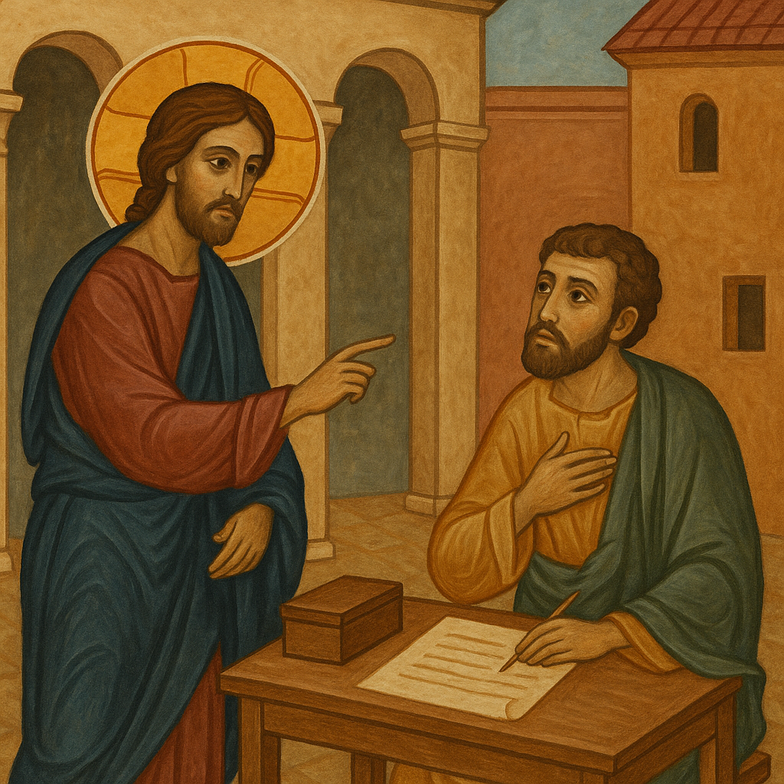
Pastor Abraham spoke on transformation this past Sunday. One of the people in the Bible when I think about transformation is Matthew Levi. Here is a message I wrote about his transformation. I hope we will all be people seeking tranformation in our lives!
Healthy or Sick, Old or New
There’s a lot of discussion about what the church’s mission is. You can ask anyone in an average church and you’ll get multiple answers. But it seems to me that the answer is pretty simple: we are supposed to do what Jesus did. His priorities should be our priorities. This event in the life of Jesus illustrates these priorities well. We’re in the events of Jesus immediately following the Sermon on the Mount. Jesus left the hillside, healed the leper and went back to Capernaum. A few days later, he taught in a house and healed the paralyzed man. We talked about that two weeks ago. We are still in week 23.
Look @ The Book
Matthew 9:9-17, Mark 2:13-22, Luke 5:27-39
Then Jesus went out to the lakeshore again and taught the crowds that were coming to him. As Jesus was walking along [and] left the town, he saw a man named Matthew Levi son of Alphaeus sitting at his tax collector’s booth. “Follow me and be my disciple,” Jesus said to him. So Matthew Levi got up, left everything, and followed him.
Later, Matthew Levi invited Jesus as the guest of honor and his disciples to his home as dinner guests, along with many tax collectors and other disreputable sinners. (There were many people of this kind among Jesus’ followers.) But when the teachers of religious law who were Pharisees saw him eating with tax collectors and other sinners, they complained bitterly to Jesus’ disciples, “Why does he (your teacher) eat and drink with such scum?”
When Jesus heard this, he told them, “Healthy people don’t need a doctor—sick people do. Then he added, “Now go and learn the meaning of this Scripture: ‘I want you to show mercy, not offer sacrifices.’ For I have come to call not those who think they are righteous, but those who know they are sinners and need to repent.”
One day when John’s disciples and the Pharisees were fasting, the disciples of John the Baptist came to Jesus and asked him, “Why don’t your disciples fast like we and the Pharisees do? Why are your disciples always eating and drinking?”
Jesus replied, “Do wedding guests fast [and] mourn while celebrating with the groom? Of course not. They can’t fast while the groom is with them. But someday the groom will be taken away from them, and then they will fast.
Then Jesus gave them this illustration: “No one tears a piece of cloth from a new garment and uses it to patch an old garment. Besides, who would patch old clothing with new cloth? For the new patch would shrink and rip away from the old cloth, leaving an even bigger tear than before. The new garment would be ruined, and the new patch wouldn’t even match the old garment.
“And no one puts new wine into old wineskins. For the old skins would burst from the pressure, spilling the wine and ruining the skins. New wine is stored in new wineskins so that both are preserved. But no one who drinks the old wine seems to want the new wine. ‘The old is just fine,’ they say.”
Healthy or sick?
- Matthew or Levi?
In Mark and Luke, the person in this event is called Levi, but in Matthew, he’s called Matthew. It’s clear from the three accounts that this is the same guy, so why the difference? To understand, we need to know a little about tax collecting. In the Roman times, taxes due the empire were collected by local people who worked with the Romans. Tax collectors were given a certain amount they had to collect for Rome, but they could add whatever amount they wanted on top of that. Since they had Roman protection, there wasn’t a lot the people could do. In Judea, tax collectors were hated intensely. They were seen as collaborators and the religious leaders taught that even associating with them defiled you. There was an active resistance in Jesus’ day by a group known as the Zealots, and one thing they did was kill tax collectors. The Romans didn’t like their flow of money being interrupted, and it was becoming difficult to find people to collect their money, so they started using teens in Judea to collect their taxes. They figured the Zealots were much less likely to kill a boy. Levi is a Hebrew name. Levi probably was born in a different part of the country, taken by the Romans, and placed in Capernaum to collect taxes. It’s likely that he was scared, and probably ashamed. That’s why he changed his name to Matthew, a Greek name, to cover his identity and probably protect his family. Mark and Luke use his given name out of respect, but Matthew was more than willing to face his own past.
Can you imagine what Matthew felt when this famous Rabbi called him? Remember that at this point, Jesus had only called 6 other people: Andrew, Peter, James, John, Phillip, and Nathaniel. Matthew must have been stunned. Why would Jesus call him, a despised tax collector, to be just like Him? Notice what it says Matthew did: he immediately got up, left the table and the money, and followed Jesus!
- Three dichotomies
Of course, the religious leaders HATED this! Jesus was breaking ALL their rules!!! And then He went and ATE with this scum. I cannot begin to describe to you how scandalous this was in that community. I find it interesting that the religious people didn’t go to Jesus to ask their question. They went to the disciples. Why did they do that, do you think?
Jesus hears their question and answers them with a question…a very rabbinic thing to do.
- Sickness or wellness
This makes a lot of sense of us, but flew in the face of everything the religious leaders of the day were teaching. You NEVER associate with sinners! They will defile you. You should only hang out with people who look like you and act like you.
- Sin or righteousness
When Jesus says “healthy” and “righteous”, to whom is He referring? The religious people, the Pharisees. Why does He call them healthy and righteous? Are they really healthy and righteous? No, but they know better. They know the Torah and all God’s commands.
So who are the sick and sinners? In the context of the passage, Jesus is speaking of the tax collectors and sinners. Jesus is clear…He’s not there for the religious people, the people who know the truth. He’s there for the people outside the family of God.
- Sacrifice or mercy
In speaking to the Pharisees, Jesus points them to a Scripture passage. He tells them to “learn” it, which was a mild rebuke. They had memorized it, but weren’t practicing it. The passage He quotes was Hosea 6:6. To completely understand what Jesus is saying, we need to take a look at this passage. In Jewish religious culture, every male memorized the majority of the Old Testament, especially the religious leaders. If you quoted a verse, then they could immediately tell you the verse before and after. A common teaching tool used by rabbis was to quote a single verse with the intent of connecting it to the larger context. Any time Jesus quotes a verse, go look at it in context! With this in mind, let’s take a look at what Jesus is saying.
First, Hosea was written by a prophet of the same name. His wife, Gomer, was unfaithful. God told Hosea to continually take her back even though she kept leaving him for other men. God uses this marriage relationship as an analogy for Himself and Israel. He is faithful to them, pours His love out on them, but they continually leave Him for other gods. Just by quoting a passage from that book, Jesus is comparing the Pharisees to the unfaithful wife. But it gets worse!
Hosea 6:5-7
I sent my prophets to cut you to pieces—to slaughter you with my words, with judgments as inescapable as light. I want you to show love, not offer sacrifices. I want you to know me more than I want burnt offerings. But like Adam, you broke my covenant and betrayed my trust.
Jesus points them here and applies it to the interaction they are having right then. So who is the prophet? Jesus. What is His role? To slaughter with words. He condemns their hollow, shadow religion they had created to replace God’s perfect Law. The whole point of God’s relationship with Israel is that He would pour His love out on them, they would follow His commands, and the nations around them would see this relationship and how amazing it is to be in relationship with God. Instead, the religious leaders had created extra rules to exclude people and make it impossible to follow God. This was a scathing rebuke of the religious leaders standing there, and I guarantee they weren’t happy!
Old or new
This section of the Bible has always confused me a little because the explanation has never made complete sense to me. Today, I hope to clear that up because as I have studied it, it has become much more clear to me.
- Religious rules
John’s disciples come to Jesus and ask about fasting. Interestingly, John’s disciples showed greater respect for Jesus because they went to Him with the question, and not His disciples. Fasting is spoken about repeatedly in the Bible, but there is only one prescribed fast in the Torah, on the Day of Atonement. The Day of Atonement was nearly 3 months away, so this was not that fast. You also see the leaders of Israel calling for fasting during times of national prayer or emergency, but these weren’t regular fasts.
The rabbis in the Talmud, though, had instituted 25 separate fasts. In addition, local synagogues could call for a fast. This idea of fasting, like so many other things, was used as a way to separate the people who “really followed God” from everyone else. “If you really followed God, you would be doing all these fasts.” Jesus is pushing back against man-made rules that were used to oppress and separate people from God.
- Patches and Wine
This is the same analogy spoken in two ways, which was a common teaching tool in Jesus’ day. The way I have heard this taught most of my life is that the old wine/cloth is bad and the new wine/cloth is good. The old represents Old Testament religion, and the new represent the new teaching that Jesus is giving. So the interpretation is that Jesus is throwing out the Law and replacing it with His new commands. Let’s consider that.
To understand what Jesus is saying, should we interpret it from our perspective today, or should we try to understand it in the context of the day Jesus said it? Of course, the latter would make more sense. To understand these, I want to focus more on the wine analogy.
In Jesus’ day, wine was used to illustrate teachings. First, did Jesus EVER say He was getting rid of the Torah? NO!!!! In fact, He repeatedly affirms and points people back to a true understanding of God’s commands. He explicitly says, “I did not come to abolish the Law.” So according to this illustration, which wine is best? In Luke 5:39, Jesus says that the old is best. The old teaching is best! We see this reflected in Jeremiah 6:16:
This is what the Lord says: “Stop at the crossroads and look around. Ask for the old, godly way, and walk in it. Travel its path, and you will find rest for your souls. But you reply, ‘No, that’s not the road we want!’
Which way is best? The old way. What is the old way? The old teaching. What is the old teaching? God’s commands given in the Torah.
If that’s the case, then what is the new teaching from the perspective of the hearers to whom Jesus is speaking? Based on the conversation Jesus is having, it’s the new teaching that was created by the rabbis over many years and added to God’s good commands. It’s the thousands of rules they created that had made it impossible for the average person to please God, at least according to their man-made rules. It’s the burdensome religion they had created that oppressed people.
So to break this down:
Old wineskins – Jesus, who is God in flesh
Old wine – The teaching given by God, the Torah
New wineskins – Us, humans
New wine – Doctrines of man
Took
To apply this, I want to work my way backward:
- Are we disciples of John or disciples of Jesus?
It’s interesting to me that it’s the disciples of John the Baptist, and not the Pharisees, that question Jesus about fasting. We normally think of the disciples of John in a positive light. Jesus’ first followers were disciples of John. There’s a whole group of John’s disciples that become Christians in Acts. John the Baptist called the Pharisees to repentance as much as anyone else. And yet here, the disciples of John identify with the Pharisees and see Jesus and His disciples as less holy because they aren’t “doing church” in the way they think it should be done.
Do we ever become like disciples of John? Do we ever have ideas about how church should be done and look down on others who don’t do it that way? If you’re honest with yourself, the answer is yes. Let me give you an example. To many Christians, if you don’t “dress up” for church, then you aren’t doing it right. If you go to a charismatic church and don’t speak in tongues, you’re not as holy.
How do you know if you’re becoming a disciple of John? Three things:
- You prefer established religious organizations and rituals.
- You criticize any manifestation of the Kingdom of God that doesn’t fit your definition of holiness, especially those that challenge our predefined beliefs.
- Are you comfortable with your beliefs and practices, or are you struggling to keep up with the draw of the Father?
- Are we focused on the healthy, or the sick?
The truth is, we’re all sick on some level. The Pharisees needed Jesus as much as the tax collectors and sinners. They just didn’t see it. So the first thing we really need to look at is our own sickness. And we’re not talking about physical illness. It’s clear in the language and in the context that Jesus is speaking of moral illness. Here’s three things to consider:
- Do you lack persistent prayer?
- Do you lack compassion toward others?
- Do you pursue God’s commands, or make excuses for ignoring them?
These three things really highlight the main point Jesus is making. If He were to make this statement in our church, who would the “healthy” be? Those of us who have heard the message of Jesus, know it, and at least say we are following Him. So who are the “sick”? The people outside our church and outside the family of God. By Jesus’ own words, who is the focus: those of us inside the church, or those outside?
Now I’m going to speak in broad strokes here. If I am doing what Jesus would do, pursuing the mission that Jesus pursued, then the words “What about me” should never come from my lips or be in my heart. If I am going to be like Jesus, then I should never be concerned about my wants, wishes, or desires when it comes to the ministry of this church. I should only and ever be thinking about what will help reach those outside the family of God. And here’s the painful truth: I have had people in churches say to my face something like, “All you ever talk about is reaching people outside the church. What about what I want?” If that’s in your heart, may I suggest that you repent, because the model Jesus gave is completely opposed to that line of thinking.
- Who are we calling to follow Jesus?
Finally, who did Jesus call to follow Him? The unlikely, the forgotten, the ignored. Jesus ate and drank with the hated, and was condemned by the religious leaders as a result. They hated Him because He broke all their rules.
I think that the Gospel writers don’t identify the other sinners that Jesus ate with because they wanted us to see ourselves in their place. There is room at the table for me…no matter what I’ve done, no matter how bad I’ve been, no matter how much the world (or the church) hates me, Jesus wants to spend time with me. If that’s true, and it is, then how can we do anything less than follow His example?
Here’s my experience: we like to invite people who look like us, smell like us, act like us, etc. We avoid the very people Jesus went out of His way to spend time with. Who would Jesus be eating with today? Who are the ones cast out by religious people? Who do you look down on in scorn? Whoever they are, those are the very people Jesus wants you to reach…the very people that need Him most. Will you obey, or will you be a Pharisee?
SONGS FOR SUNDAY
Lion and the Lamb
https://www.youtube.com/watch?v=C9ujBoud26k&list=RDC9ujBoud26k&start_radio=1
Trust in God
https://www.youtube.com/watch?v=iJE4yahElBQ&list=RDiJE4yahElBQ&start_radio=1
This I Believe
https://www.youtube.com/watch?v=uuDI-sk2nJU&list=RDuuDI-sk2nJU&start_radio=1
Great Are You Lord
https://www.youtube.com/watch?v=hpb02shcAis&list=RDhpb02shcAis&start_radio=1